




Menu Covers · Wood · Materials & Finishes
Wooden menu covers are the most durable, most customisable and most visually distinctive option in professional hospitality. But not all wood is the same — and the difference between a cover that lasts two years and one that lasts ten comes down to material, finish and how it is maintained.
This guide covers everything a restaurant, café or bar owner needs to know before ordering wooden menu covers: which wood types and finishes are available, how laser engraving works in practice, which fixing mechanisms suit which service styles and how to match the cover to the concept of the venue.
If you are comparing wooden covers against leather or faux leather alternatives, this guide will also give you the data to make that decision with confidence.
Why Restaurants Choose Wooden Menu Covers
 Wood is the only menu cover material that communicates a specific set of values without any text. When a guest picks up a wooden menu folder, they receive an immediate signal: this establishment cares about natural materials, craftsmanship and authenticity. That signal is processed before the guest reads a single item on the menu.
Beyond the sensory impression, wooden covers offer practical advantages that other materials do not:
- Structural rigidity — wood does not bend, warp or lose its shape under normal use. A wooden cover holds its form after thousands of handling cycles in a way that leather and faux leather cannot match.
- Surface durability — a properly finished wooden surface resists scratches, surface stains and the kind of daily wear that degrades softer materials quickly.
- Laser engraving compatibility — wood accepts laser engraving better than any other menu cover material. The result is sharp, permanent and requires no additional ink, foil or coating.
- Longevity — with basic maintenance, a quality wooden menu cover lasts five to eight years or more in professional use. That is a significantly longer lifespan than faux leather and comparable to genuine leather at a lower price point.
The trade-off is weight and moisture sensitivity. Wooden covers are heavier than leather or faux leather alternatives and require protection from prolonged exposure to water. These are manageable considerations in most professional environments — but they are worth understanding before ordering.
Wood Types and Finishes: What the Difference Actually Means
Most wooden menu covers on the market are made from plywood rather than solid wood. This is not a compromise — it is the correct choice for professional use. Plywood is dimensionally stable, resistant to warping and consistent in thickness across the entire panel. Solid wood moves with humidity changes in ways that plywood does not, which makes it less reliable in a restaurant environment where temperature and moisture levels fluctuate throughout the day.
Within plywood construction, the finish and surface treatment determine the visual character of the cover. Here is what each option delivers:
Light Wood (Natural / Birch Finish)
Light wood finishes — natural birch, pale oak tones, uncoated plywood — suit minimalist, Scandinavian and modern interiors. The grain is subtle and the overall effect is clean and unobtrusive. Light wood covers work particularly well in venues where the interior uses white walls, concrete surfaces or pale timber furniture.
Laser engraving on light wood produces a medium-contrast result — the engraved area darkens to a warm brown against the pale surface. This is visible and legible without being visually aggressive.
Best for: Scandinavian cafés, modern bistros, brunch spots, minimalist hotel restaurants, venues with pale or neutral interiors.
Dark Wood (Wenge / Dark Oak Finish)
Dark wood finishes — wenge, dark walnut tones, ebonised surfaces — communicate premium quality and formality. They suit classic, industrial and upscale casual interiors where the furniture and fittings are predominantly dark. A dark wooden menu cover on a dark timber table creates a cohesive, intentional presentation that guests notice.
Laser engraving on dark wood produces a high-contrast result — the engraved area is lighter than the surrounding surface, making logos and text stand out clearly. This is the most visually striking engraving result available across all menu cover materials.
Best for: Steakhouses, craft breweries, whiskey bars, classic restaurants, industrial-concept venues, any establishment with dark timber or metal interior elements.
Mixed Wood and Leather Spine

Some wooden covers combine a plywood panel with a leather spine. This construction adds flexibility at the hinge point — the cover opens and closes more smoothly than a fully rigid wooden folder — while retaining the visual character of wood on the front and back panels. The leather spine also adds a tactile contrast that guests notice when they first handle the cover.
Best for: Venues that want the look of wood with the handling quality of a leather folder. Works well in casual fine dining and upscale bistro settings.
Hardcover Wooden Covers
 Hardcover wooden covers use a thicker panel construction — typically HDF (high-density fibreboard) or multi-layer plywood — that gives the cover a substantial, book-like weight and feel. These are the most premium wooden option and are suited to venues where the menu is a centrepiece of the table presentation rather than a functional afterthought.
Best for: Fine dining, hotel restaurants, wine bars, any venue where the weight and presence of the cover is part of the guest experience.
Browse the full range of wooden menu covers — light, dark, hardcover and mixed wood-leather options available in A4, A5, US Letter and custom sizes:
Browse Wooden Menu CoversWood Finish Comparison: Quick Reference
| Finish | Visual Character | Engraving Contrast | Best Interior Style | Lifespan |
|---|---|---|---|---|
| Light / Natural | Clean, minimal, pale grain | Medium — warm brown on pale | Scandinavian, minimalist, modern | 5–8+ years |
| Dark / Wenge | Rich, premium, deep grain | High — light mark on dark | Classic, industrial, steakhouse | 5–8+ years |
| Wood + Leather Spine | Warm, tactile, two-material | Medium to high depending on wood | Casual fine dining, upscale bistro | 5–7 years |
| Hardcover (HDF) | Substantial, book-weight, premium | High — sharp and permanent | Fine dining, hotels, wine bars | 7–10+ years |
Laser Engraving on Wooden Menu Covers: How It Works and What to Expect

Laser engraving is the standard branding method for wooden menu covers and the reason wood outperforms every other material for custom logo presentation.
The Process
A laser beam removes a controlled layer of the wood surface, burning away the material to a precise depth. The result is a permanent mark that is part of the wood itself — not applied on top of it. It cannot peel, fade or wear off through handling. The engraved area has a slightly textured surface that guests can feel when they run their fingers across the cover.
What Works Well for Engraving
- Logos with clean lines — vector-format logos with defined edges engrave with the highest precision.
- Text — restaurant names, slogans, URLs and table numbers all engrave cleanly. Minimum recommended font size is approximately 8pt for legibility.
- Geometric patterns — borders, frames and decorative elements engrave consistently across the full panel.
- Illustrations — line-based illustrations and icons engrave well. Photographic images with gradients are less suited to standard laser engraving.
Engraving Contrast by Wood Finish
On light wood, the engraved area darkens to a warm amber-brown — the contrast is moderate and the result is elegant. On dark wood (wenge), the engraved area is lighter than the surrounding surface — the contrast is high and the logo is immediately visible from across the table. Both results are permanent and require no maintenance.
File format note: For the sharpest engraving result, provide your logo as a vector file (AI). Raster files (PNG, JPG) can be used but may show reduced edge sharpness at small sizes. If you only have a raster file, a resolution of at least 300 DPI at the intended engraving size will produce an acceptable result.
Fixing Mechanisms for Wooden Menu Covers
The fixing mechanism determines how menu inserts are held inside the cover and how quickly they can be changed. For wooden covers specifically, the choice of mechanism also affects the visual profile of the cover — some mechanisms are visible from the front and contribute to the aesthetic, while others are concealed.
Leather Strap
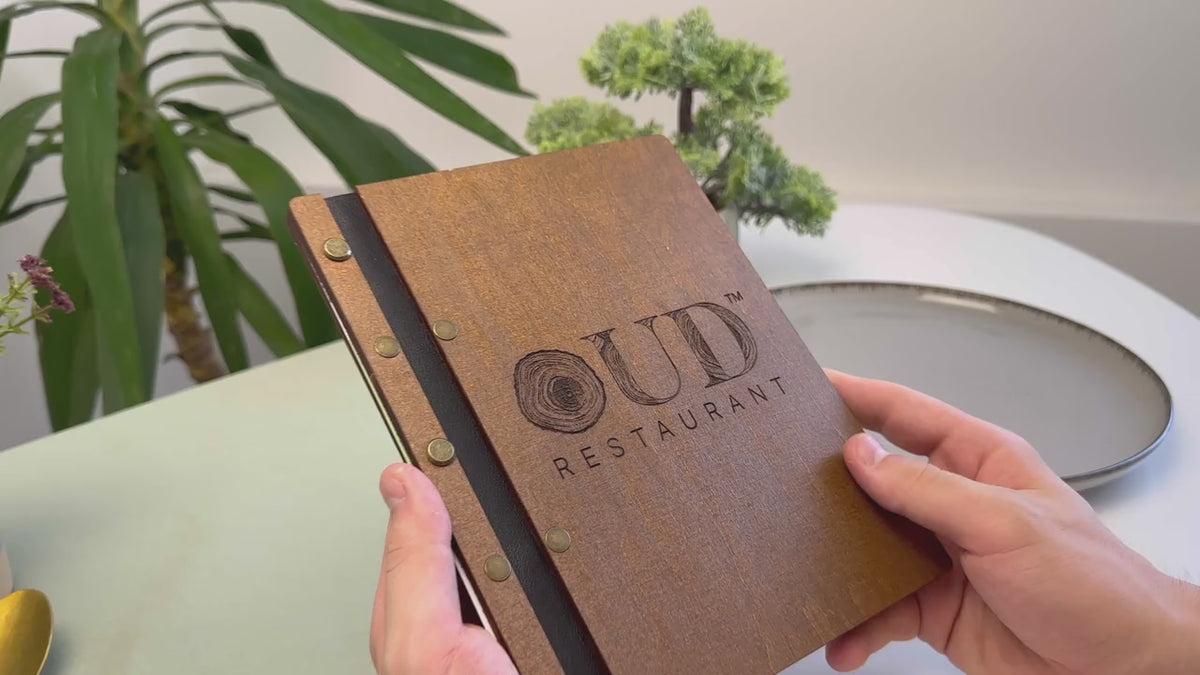
A leather strap wraps around the closed cover to hold it shut. Inserts are placed between the wooden panels and held in position by the strap tension. This is the most visually distinctive fixing option — the strap is visible on the outside of the cover and contributes to the overall aesthetic. It is also the fastest to use: unwrap, replace the insert and rewrap.
Best for: Rustic, artisanal and craft concepts. Wine lists, cocktail menus and any format where the cover is presented closed and opened at the table.
Ring Binder
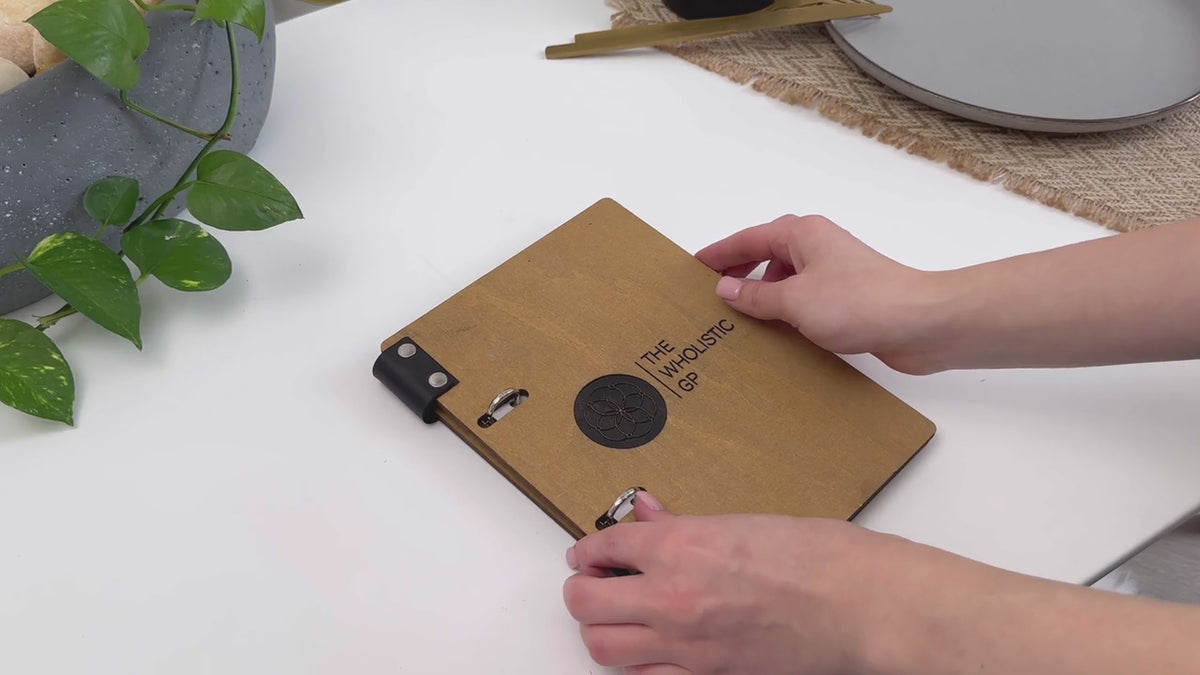
Metal rings are mounted on the spine of the cover. Punched pages are threaded onto the rings and can be added or removed individually. This is the most operationally flexible option — individual pages can be swapped in seconds without removing the entire insert set.
Best for: Multi-page menus, wine lists with many entries, rotating tap lists, any menu that changes frequently at the page level rather than the full insert level.
Screws and Plank
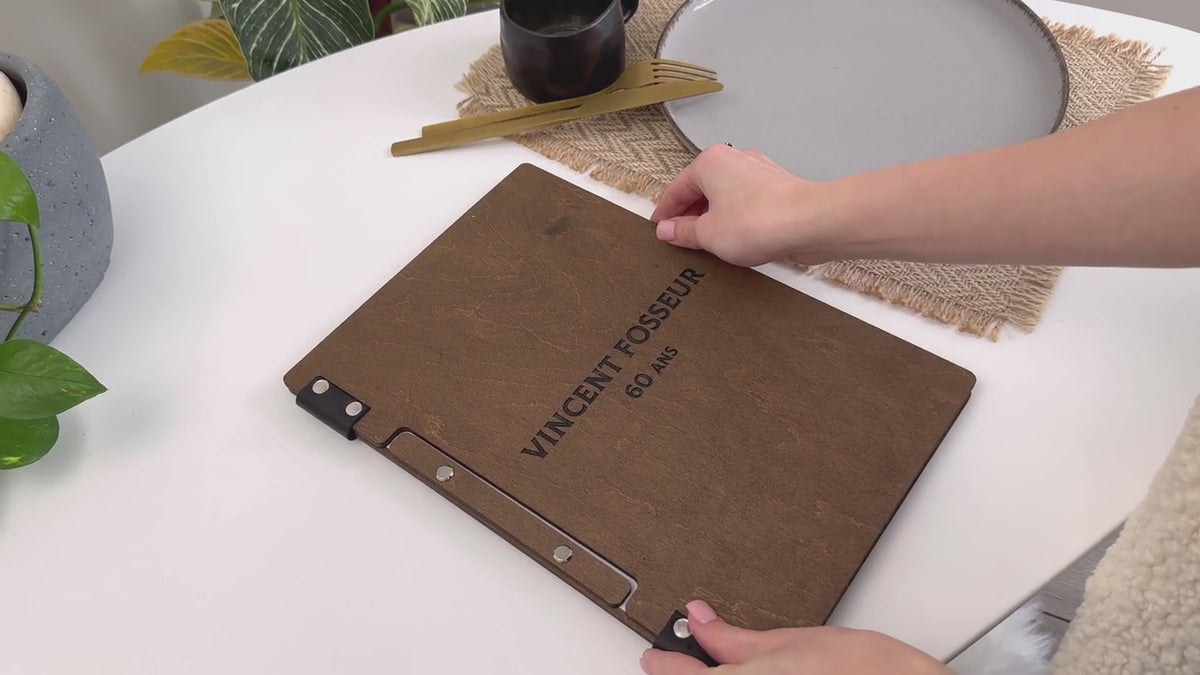
Pages are clamped between a wooden plank and the cover panel using decorative screws. The screws are visible on the front of the cover and contribute to the industrial or artisanal aesthetic. Changing inserts requires unscrewing the plank — slower than a strap or ring binder but producing a cleaner, more permanent-looking result.
Best for: Menus that change seasonally rather than daily. Industrial, craft and rustic concepts where the visible hardware is part of the design.
Corner Mountings

Metal or leather corners hold a single sheet in place at each corner. The insert slides in and out without any tools. This is the cleanest visual option — no hardware is visible on the front of the cover — and the fastest for single-sheet formats.
Best for: Single-sheet menus, elegant minimal presentation, venues where the cover surface should be uninterrupted.
When to Choose Wood Over Leather or Faux Leather
The decision between wood and leather is not purely aesthetic — it has practical implications for maintenance, durability and how the cover performs in different service environments.
| Factor | Wooden Cover | Genuine Leather | Faux Leather |
|---|---|---|---|
| Structural rigidity | ★★★★★ — does not bend | ★★★☆☆ — flexible, can soften | ★★☆☆☆ — bends with use |
| Branding quality | ★★★★★ — laser engraving | ★★★★☆ — embossing, foil | ★★★☆☆ — embossing, printing |
| Moisture resistance | ★★★☆☆ — wipe immediately | ★★★★☆ — dry wipe, no soaking | ★★★★☆ — easy wipe clean |
| Tactile quality | ★★★★☆ — smooth, solid, warm | ★★★★★ — soft, warm, premium | ★★★☆☆ — smooth but synthetic |
| Lifespan | 5–8+ years | 5–10+ years | 2–4 years |
| Maintenance | Wipe clean, avoid moisture | Dry wipe + condition 2–3× per year | Wipe clean, no conditioning |
| Concept fit | Rustic, craft, Scandinavian, industrial | Fine dining, hotels, wine bars | Casual dining, high volume |
Choose wood when: the venue concept is rustic, craft, artisanal, Scandinavian or industrial; when laser-engraved branding is a priority; when structural rigidity matters more than softness; or when the cover will be handled roughly and needs to hold its shape over years of use.
Choose leather when: the venue is fine dining or hotel-grade and the softness and warmth of the material is part of the premium experience. Leather menu covers are the better choice for venues where tactile quality is the primary consideration.
Choosing the Right Wooden Menu Cover for Your Venue
The right wooden cover depends on three variables: the concept of the venue, the format of the menu and the frequency of menu updates. Here is a practical guide by establishment type.
Craft Breweries and Beer Pubs

Recommended: Dark wood finish with screws and plank fixing. The visible hardware — decorative screws and a wooden plank — suits the industrial and artisanal character of most brewery interiors. The plank fixing gives the cover a raw, confident look that works with dark wenge finishes and exposed-material décor. Laser-engraved logo on the front panel. Menus in this format typically change seasonally rather than daily, so the slightly slower insert swap is not an operational issue.
Size: A4 for the main menu. Slim 2/3 A4 or A5 for drinks-only formats.
Rustic Restaurants and Farm-to-Table Venues
 Recommended: Light or medium wood with leather strap or leather spine. The combination of wood and leather reinforces the natural, handcrafted aesthetic that farm-to-table and rustic concepts communicate. The leather strap adds a tactile element that guests engage with when they open the cover.
Size: A4 for the main menu. A5 for wine and specials.
Pizzerias and Casual Italian Restaurants
Recommended: Light wood with plank fixing or leather strap. The plank fixing adds a visible hardware element that suits the informal, artisanal character of a pizzeria. Light wood keeps the presentation approachable rather than formal.
Size: A4 or US Letter. Landscape formats work well for single-page pizza menus.
Scandinavian and Minimalist Cafés

Recommended: Light wood hardcover with corner mountings. The hardcover format gives the cover a clean, book-like presence that suits minimalist interiors. Corner mountings keep the front surface uninterrupted. A small, precisely engraved logo in the lower corner is the most effective branding approach for this concept.
Size: A5 or Half Letter. Minimalist cafés rarely need A4.
Wine Bars and Cocktail Venues

Recommended: Slim wooden wine list cover with leather strap. Wine and cocktail lists are typically narrower than food menus — a slim 2/3 A4 or A5 format suits the content without excess. The leather strap closure adds a premium touch that is appropriate for the price point of most wine and cocktail offerings.
Size: A5, 2/3 A4 or slim custom formats. Avoid A4 for drinks-only lists — it is too large for the content.
Need a complete matched set — wooden menu covers, check presenters and table accessories in the same finish and style?
View Ready-Made Restaurant SetsHow to Care for Wooden Menu Covers
Wooden covers are low-maintenance compared to leather but they do require basic care to maintain their appearance and extend their lifespan.
- Daily cleaning: Wipe with a soft dry or slightly damp cloth after each service.
- Spills: Wipe immediately with a dry cloth. Do not allow liquid to sit on the surface.
- Deep cleaning: Use a mild soap solution applied to the cloth, not directly to the wood. Wipe dry immediately after. Do not use abrasive cleaners, products containing acids or chlorine.
- Conditioning: Unfinished or lightly finished wooden covers benefit from occasional treatment with a natural wood oil or conditioner — once or twice per year is sufficient.
- Storage: Store covers flat or upright in a dry environment. Avoid stacking heavy objects on top of covers or storing them near heat sources, steam equipment or direct sunlight.
Important: Never use alcohol-based wipes, bleach or disinfectant sprays directly on wooden covers. These strip the surface finish and cause discolouration over time. A dry microfiber cloth handles the vast majority of daily cleaning needs without any chemical products.
What are wooden menu covers made from?
How long do wooden menu covers last in a restaurant?
Can wooden menu covers be laser engraved with a logo?
Which fixing mechanism is best for a menu that changes frequently?
Are wooden menu covers water-resistant?
What sizes are available for wooden menu covers?
Wooden menu covers are one of the few hospitality investments that improve the guest experience, reduce long-term costs and communicate brand values simultaneously. The right combination of finish, fixing mechanism and size turns a functional object into a consistent part of what guests remember about a visit.


Leave a comment
This site is protected by reCAPTCHA and the Google Privacy Policy and Terms of Service apply.