




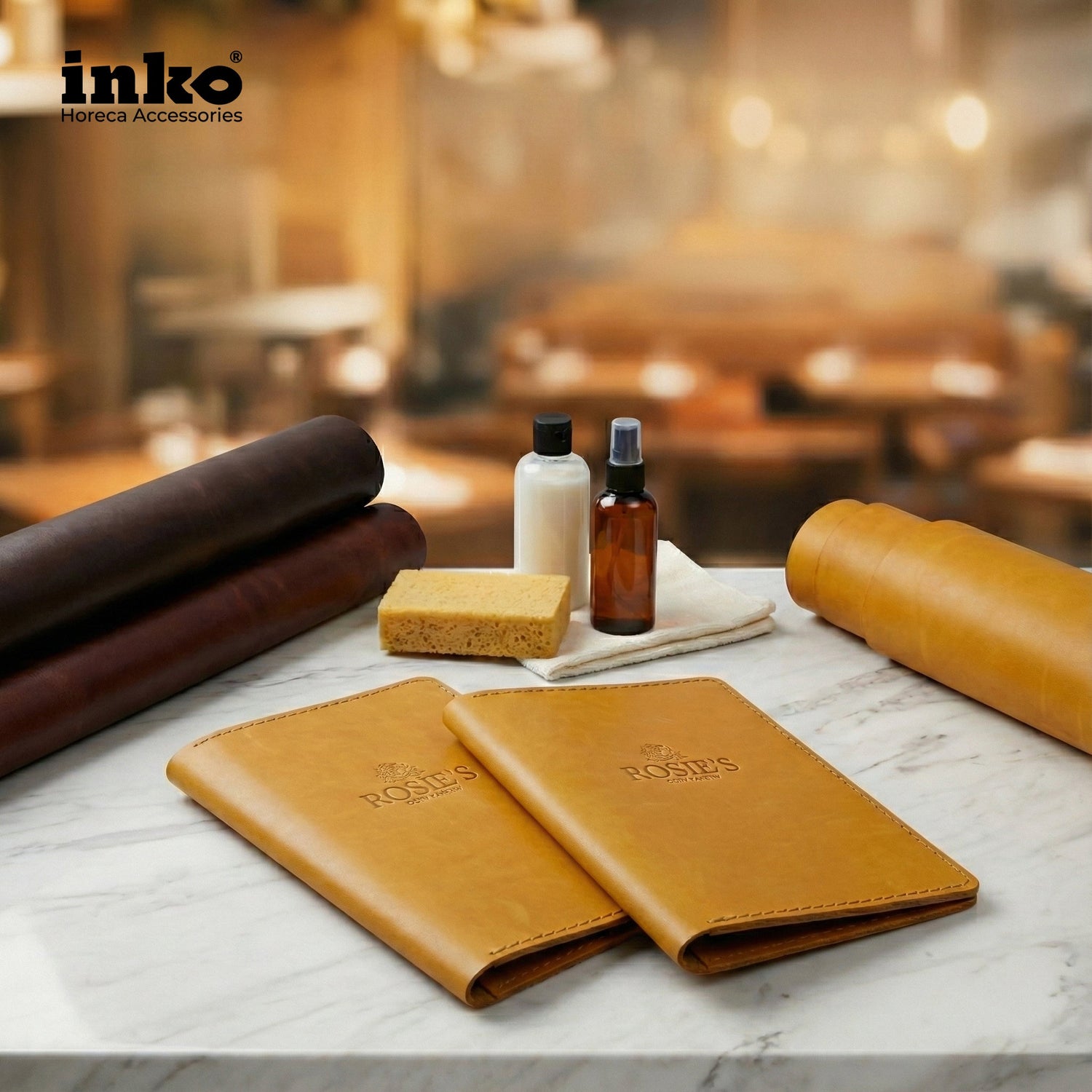
Leather Care · HoReCa Materials · Restaurant Presentation
Genuine leather is one of the few materials that improves with age. But only if you treat it correctly. In a professional environment — restaurants, hotels, cafеs the difference between a menu cover that lasts two years and one that lasts ten comes down to a routine that takes less than two minutes a day.
Most operators buy quality leather products and then clean them with whatever is available: alcohol wipes, kitchen spray, a damp cloth wrung out in hot water. The leather survives for a while and then it doesn't. The surface cracks, the colour shifts and the cover that was supposed to signal quality starts signalling neglect instead.
This guide covers how genuine leather actually behaves, what damages it, and what a practical care routine looks like for professional use. It applies to leather menu covers, check presenters, wine list holders and any other leather accessory in daily service.
What Genuine Leather Actually Is

Leather is tanned animal hide built from a dense network of collagen fibres. That structure gives it three properties that matter in professional use: it is strong and tear-resistant, flexible and comfortable to handle and slightly porous so it breathes. The porosity is also what makes it vulnerable. Because leather can absorb, it will absorb the wrong things if you let it.
Full-Grain, Top-Grain and the Patina Question
Premium leathers - full-grain and top-grain, are often drum-dyed and sometimes oiled or waxed. They show natural variation in grain and shade. Over time they develop a patina: a soft, deepened surface quality that comes from handling and light exposure. This is not wear. It is the material doing what it is supposed to do.
True damage looks different: deep cracks across the surface, peeling layers, strong discoloration after contact with a harsh chemical. If you see patina developing on a leather menu cover after six months of service, that is a good sign. If you see cracking after six months, something in the care routine is wrong.
Worth knowing: Crazy horse leather used in several InkoHoreca products - is a pull-up leather with a wax finish. Scratches and pressure marks appear as lighter areas on the surface. Rubbing them with a fingertip generates heat that redistributes the wax and the mark disappears. This is a feature of the material, not a defect.
How Genuine Leather Behaves Under Professional Conditions
Water and Moisture
- Brief contact with water is fine if you blot it immediately and let the leather dry at room temperature.
- Soaking or drying on a heat source makes leather stiff and brittle. The fibres contract unevenly and the surface cracks.
- Sustained humidity, a damp storage room, a cover left wet between services - causes deformation, mold and odour that cannot be reversed.
Oils, Fats and Friction
- Skin oils and food fats darken areas that are handled frequently. On oiled leathers this blends into the patina naturally. Heavy kitchen fats can leave permanent stains if not addressed quickly.
- Rough surfaces, sharp edges and repeated bending on dry leather create scratches and eventually surface breakage. Conditioning prevents this by keeping the fibres supple.
Chemicals
- Alcohol strips the natural oils from leather immediately. A single wipe with an alcohol-based cleaning product can dry out the surface enough to cause cracking within weeks.
- Bleach, ammonia and strong degreasers break down the tanning agents in the leather itself. The damage is permanent and progressive.
- Vinegar and bicarbonate of soda common "natural cleaning hacks", are acidic or alkaline enough to alter the leather's pH and cause discoloration.
Daily Leather Care: The Two-Minute Routine
Daily care prevents contamination from building up and keeps the surface in good condition between deeper cleans. It takes less time than wiping down a table.
Step 1 - Dry Wipe

- Take a soft, dry microfiber cloth.
- Wipe the full surface to remove dust, crumbs and fingerprints.
- Pay attention to edges, folds and seams where debris collects.
Step 2 - Deal with Fresh Marks Immediately

- Blot, do not rub. Rubbing spreads the stain and pushes it deeper into the pores.
- Use a clean dry cloth to absorb as much liquid as possible.
- If needed, lightly dampen a second cloth with plain water and wipe once across the area.
- Leave the leather to dry at room temperature. Do not apply heat.
Step 3 - Let It Breathe

Do not stack leather items tightly while damp. Leave space for air circulation between services. Avoid sealed plastic bags or fully closed boxes for anything other than long-term storage.
Periodic Deep Cleaning: Step-by-Step
Schedule a deeper clean every few weeks depending on service volume. A busy restaurant running two sittings per day will need this more often than a quiet wine bar with a single evening service.

- Dust off: remove loose dirt with a dry cloth before applying anything wet.
- Apply cleaner to the cloth, not the leather: put a small amount of pH-neutral leather cleaner on a soft cloth first.
- Test on a hidden area: check for colour change or texture shift before cleaning the full surface.
- Clean with light circular motions: the surface should be only slightly damp, never wet.
- Remove residue: wipe once more with a clean, lightly damp cloth if needed.
- Dry naturally: leave at room temperature, away from heaters, radiators and direct sunlight.
Conditioning
If the leather feels dry or slightly stiff after cleaning, apply a quality leather conditioner:
- Apply a thin, even layer with a soft cloth.
- Work it in and allow it to absorb fully before use.
- Buff gently with a clean cloth to remove any excess.
For most professional environments, conditioning every two to three months is sufficient. High-use items in dry or air-conditioned spaces may need it more frequently.
What You Must Never Do to Genuine Leather
- Do not use bleach, chlorine, ammonia, strong degreasers or any product not formulated for leather.
- Do not clean with alcohol-based wipes including standard hospitality sanitising wipes.
- Do not wash under running water or soak in any liquid.
- Do not dry on radiators, with a hairdryer or in direct sunlight through glass.
- Do not scrub with hard brushes, abrasive sponges or rough cloths.
- Do not use vinegar, bicarbonate of soda or any "natural hack" not tested on leather specifically.
The most common mistake in hospitality: using the same sanitising wipe on leather menu covers that staff use on tables. Alcohol-based sanitisers are effective on hard surfaces. On leather they strip the natural oils from the surface with every application. The damage accumulates invisibly until the surface starts to crack. By that point it cannot be reversed.
Solving Common Leather Problems
Water Spots and Rings
- Minor rings often disappear as the leather re-absorbs moisture evenly during drying.
- If a ring remains, very lightly dampen a slightly larger area around it with a barely damp cloth and allow it to dry again. This evens out the moisture boundary.
Oil and Grease Stains
- Blot excess oil immediately with a dry cloth. Do not rub and do not add water.
- Use a specialised leather degreaser only after testing on a hidden area first.
- On dark oiled leathers, a small stain may blend into the patina over time without any intervention.
Scratches and Surface Marks
- On pull-up and crazy horse leathers, light scratches respond to gentle rubbing with a fingertip. The heat redistributes the wax finish and the mark softens or disappears.
- On smooth finished leathers, light marks can be reduced with a conditioner applied to the area.
- Deep cuts cannot be fully removed but become less visible after conditioning.
Colour Migration
- Richly dyed leathers may transfer slight colour under friction and moisture during the first weeks of use.
- Wipe new items with a dry cloth several times before putting them into full service and avoid contact with very light-coloured textiles initially.
Storage Guidelines for Genuine Leather
| Condition | What to Do | What to Avoid |
|---|---|---|
| Temperature | Cool, stable room temperature | Near heaters, radiators or in direct sun |
| Humidity | Moderate, stable humidity | Damp basements or very dry air-conditioned rooms |
| Light | Shaded, indirect light | Direct sunlight or strong UV sources |
| Ventilation | Fabric covers or open cardboard boxes | Sealed plastic bags or airtight containers |
| Pressure | Stored flat or upright with space around | Heavy objects stacked on top |
Before long-term storage, clean the leather fully and allow it to dry completely. Apply a light coat of conditioner if the surface feels dry. After storage, wipe off any dust and inspect the surface before returning items to service.
Leather Care as a System: Quick Reference Checklist
| Frequency | Action |
|---|---|
| Every day | Dry wipe with microfiber cloth. Blot fresh marks immediately. |
| Every few weeks | Clean with pH-neutral leather cleaner. Dry naturally away from heat. |
| Every 2-3 months | Condition if leather feels dry or stiff. Check for deeper damage. |
| Always | Avoid alcohol wipes, harsh chemicals and heat drying. Store with ventilation. |
From InkoHoreca: The leather products we supply are selected for professional use in restaurants, hotels and cafés. They are built to handle daily service. What shortens their life is not use - it is the wrong cleaning products applied consistently over time. A simple routine with the right materials keeps them in service for years and lets the patina develop the way it should.
Browse our full range of genuine leather menu covers and accessories - built for professional use and available with custom branding:
Browse Leather Menu CoversNeed a matched set - menu covers, check presenters and table accessories in the same leather finish?
View Ready-Made Restaurant SetsHow do you clean genuine leather menu covers in a restaurant?
Can you use alcohol wipes on leather?
How often should you condition genuine leather?
What is patina on leather and is it a problem?
How do you remove an oil or grease stain from a leather menu cover?
How long do genuine leather menu covers last with proper care?


Leave a comment
This site is protected by reCAPTCHA and the Google Privacy Policy and Terms of Service apply.