




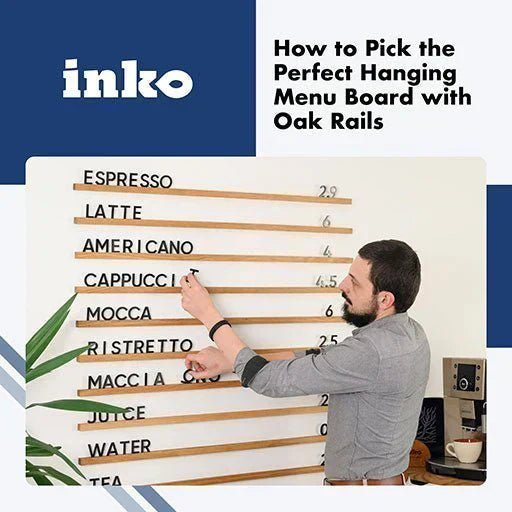
A hanging menu board with oak rails is one of the most visible decisions you make for your venue. It sits on the wall every service, every day — and every guest who walks in reads it before they read anything else. Get it right and it becomes part of what makes your space feel considered. Get it wrong and it's a board that's too small, the wrong finish, or impossible to update without a ladder and twenty minutes you don't have.
This guide covers everything that actually matters when choosing one: size, oak finish, mounting, update flexibility and long-term value. No filler — just what you need to make the right call for your specific venue.
Quick Reference: What to Decide Before You Order
- Size — measure the wall first, then match to your menu length
- Oak finish — natural, oiled, brown or black depending on your interior
- Update method — printed inserts, letter tiles or chalk: choose based on how often you change the menu
- Mounting height — 5 to 6 feet from the floor for comfortable reading at standing eye level
- Single or multi-panel — one large board or two to three narrower panels side by side
Why Oak Rails Specifically
Oak is the standard for menu board rails because it performs well in the conditions a working hospitality venue actually creates. It is dense, resistant to warping and handles the humidity and temperature fluctuations that come with a kitchen environment. Pine and MDF alternatives absorb moisture and can swell or crack within a year or two. Oak does not.
Beyond durability, oak has a visual weight that reads as quality without being decorative in a forced way. The natural grain adds texture that works across very different interior styles — industrial spaces, Scandinavian cafés, traditional dining rooms and modern bistros all carry oak rails without the board looking out of place.
The rails are available in four finishes, each with a distinct character:
- Natural oak — light, raw-looking, suits pale wood interiors and minimal design
- Oiled oak — slightly deeper tone, more protected surface, works across most styles
- Brown oak — warm mid-tone, suits classic and traditional interiors
-
Black-stained oak — high contrast, suits industrial, modern or dark-toned spaces

Choosing the Right Size
Size is the most common mistake when ordering a hanging menu board. Too small and it looks like an afterthought. Too large and it overwhelms the wall or becomes hard to read at close range.
Before you look at any product, measure the wall. Note the full available width and height, including clearance from shelves, windows, lighting fixtures and any other signage. Then work backwards from your menu content.
| Venue Type | Recommended Format | Notes |
|---|---|---|
| Small café or coffee bar | Single board, A3 or A4 inserts | Short menu — one board is enough |
| Bistro or neighbourhood restaurant | Two boards side by side | Separate food and drinks, or lunch and dinner |
| Craft brewery or pizzeria | Two to three boards | Rotating tap lists need space and easy update access |
| Bar or cocktail venue | Single compact board or two narrow panels | Drinks menus are shorter — compact formats work well |
| Full-service restaurant | Three-panel layout | Starters, mains and desserts each get their own panel |
If your menu changes frequently or seasonally, size up slightly. Having room to add items without redesigning the layout saves time and avoids the need to reorder a larger board later.
Viewing distance matters too. A board behind a counter that guests read from 10 feet away needs larger text and more spacing between items than a board at table height read from 3 feet. Factor this into how much content you try to fit on a single panel.
Matching the Finish to Your Interior
The oak finish is not just an aesthetic choice — it affects how the board reads in the room and how well it holds up over time. Oiled finishes are more protected than raw natural finishes and require less maintenance. Black-stained oak is the most durable surface finish of the four.
A common mistake is choosing a finish based on the product photo rather than the actual lighting in the venue. Natural oak looks very different under warm incandescent light than under cool LED strips. If possible, order a sample or check the finish in person before committing to a full board.
General guidance by interior style:
- Scandinavian or minimal — natural or oiled oak with light wood furniture and white or grey walls
- Industrial or urban — black-stained oak against exposed brick, concrete or dark metal fixtures
- Traditional or classic dining — brown or oiled oak with darker furniture and warm lighting
- Modern bistro or café — oiled or natural oak works across most contemporary interiors
How Easy Is It to Update?
This is the practical question that most buyers overlook until after they have installed the board. If updating your menu takes 20 minutes and a screwdriver, you will avoid doing it — and your displayed menu will fall behind your actual offering. That creates confusion for guests and extra work for staff.
There are three main update methods for hanging menu boards with oak rails:
- Printed insert panels — the most common format. A printed sheet (A3, A4 or custom size) slides into the frame held by the rails. Swapping takes under a minute. Best for venues that update weekly or seasonally.
- HDF letter tiles — individual letters and numbers slot into the board manually. No printing required. Best for venues that change prices or specials daily and want to avoid print costs entirely.
- Chalk or chalk marker — written directly onto a chalk surface panel. Maximum flexibility, zero print cost. Requires neat handwriting or a staff member who can letter consistently.
For most restaurants and cafés, printed inserts are the right choice. They look clean, are easy to produce in-house with a standard printer and can be updated as often as needed without any tools
Acrylic Letter Boards: Change Your Menu in Seconds
If your prices change often or you run daily specials, acrylic letter boards are worth serious consideration. Instead of printing a new insert or writing on chalk, you simply slide individual letters and numbers in and out of the oak rails by hand. Price changed? Swap one digit. New dish added? Slot in the name. The whole update takes seconds — no printer, no chalk dust and no waiting.

The letters are glossy black acrylic — sharp, high-contrast and readable from across the room. They sit in the grooves of the oak rails and stay in place without adhesive or fixings. The result looks clean and intentional, not improvised.

This is exactly how one of our clients uses it in their café — a full drinks menu displayed on oak rails with black acrylic letters. Clean, readable and updated whenever the offering changes without any tools or outside help.
With printed menus, a price change means a reprint — and reprints cost time and money. With acrylic letter boards, a price change means moving one tile. For venues that update their offering weekly or run seasonal pricing, the savings add up quickly.

What comes in the set: Each full set includes 10 oak rails and 400 acrylic letters and numbers. The set covers both black and white glossy options. Multiple copies of the most-used letters are included so you are not limited by a single instance of a common character. If your venue has limited wall space, a half-set of 5 rails with the full 400-letter pack is also available — same flexibility, smaller footprint.

The letter count per character is shown above — designed so that the most frequently used letters (E, T, A, S, N) appear in higher quantities. If you ever run out of a specific letter after heavy use, replacement sets are available separately.
Mounting: Getting It Right the First Time
A hanging menu board is only as good as its installation. Poor mounting leads to boards that tilt, vibrate when doors open or — in the worst case — fall. None of these outcomes are acceptable in a venue with guests present.
- Height — mount so the centre of the board sits at 5 to 6 feet from the floor. This puts the reading area at comfortable eye level for standing adults.
- Fixings — use stainless steel screws and anchors. Standard steel rusts in kitchen-adjacent environments within months.
- Wall structure — fix into wall studs where possible. If the wall is tiled, plastered or uneven, use appropriate anchors rated for the board's weight and consider professional installation.
- Level — use a spirit level. A board that is even slightly off looks unprofessional and is immediately noticeable to guests.
-
Lighting — a board in a dim corner loses its impact entirely. Directional spotlights or warm overhead lighting make oak rails look significantly better and improve readability from a distance.

Maintaining an Oak Rail Board
Oak is low-maintenance — but not zero-maintenance. A board that is wiped down regularly and occasionally re-oiled will look good for ten years or more. One that is ignored will dry out, crack or discolour within a few years.
- Wipe rails with a dry or slightly damp cloth after each service — avoid soaking the wood
- Apply a food-safe wood oil every 6 to 12 months to maintain the finish and prevent drying
- Keep the board away from direct steam sources — dishwashers and coffee machines accelerate drying and warping
- Check fixings every few months — vibration from foot traffic and doors can loosen screws over time
- If the surface gets scratched, light sanding followed by re-oiling usually restores it without needing replacement
The Cost Argument
Oak rail menu boards cost more upfront than plastic or MDF alternatives. The comparison changes when you factor in lifespan and the cost of replacement.
A well-made oak board in a normal restaurant environment lasts 10 to 15 years. A cheap plastic frame typically needs replacing every 2 to 3 years — and looks tired well before that. Over a decade, the oak option is often cheaper in total. It also does not create the visual impression of a venue that cuts corners on presentation.
There is a less tangible benefit too. The board contributes to how guests perceive the venue. A well-presented menu display signals care and quality. That perception affects what people order and what they are willing to pay. A well-chosen menu presentation is part of the overall experience you are creating — and the wall board is one of the most visible parts of it.
Checklist: Before You Order
- ✓ Measured the exact wall dimensions where the board will hang
- ✓ Decided on single board or multi-panel layout
- ✓ Chosen the oak finish that suits the interior
- ✓ Confirmed the paper size your current menu uses
- ✓ Decided on update method (printed inserts, letter tiles or chalk)
- ✓ Checked whether custom branding (logo, venue name) is needed on the board
- ✓ Confirmed who will install it and what fixings are needed for the wall type
What size hanging menu board do I need for my restaurant?
What is the difference between natural, oiled and black oak rails?
How do I update the menu on a hanging oak rail board?
How high should a hanging menu board be mounted?
How long does an oak rail menu board last?
What is included in the acrylic letter set for a menu board?
Can I get a hanging menu board with custom branding?
A hanging menu board with oak rails is a long-term fixture — not a consumable. The right choice depends on getting three things right: the size relative to your wall and menu content, the finish relative to your interior and the update method relative to how often your menu actually changes. Get those three right and the board will serve the venue well for years without requiring attention. Get them wrong and you will be looking at a replacement within a season.
If you are still deciding between formats or finishes, browsing the full range side by side is the most practical way to narrow it down.

Leave a comment
This site is protected by reCAPTCHA and the Google Privacy Policy and Terms of Service apply.