




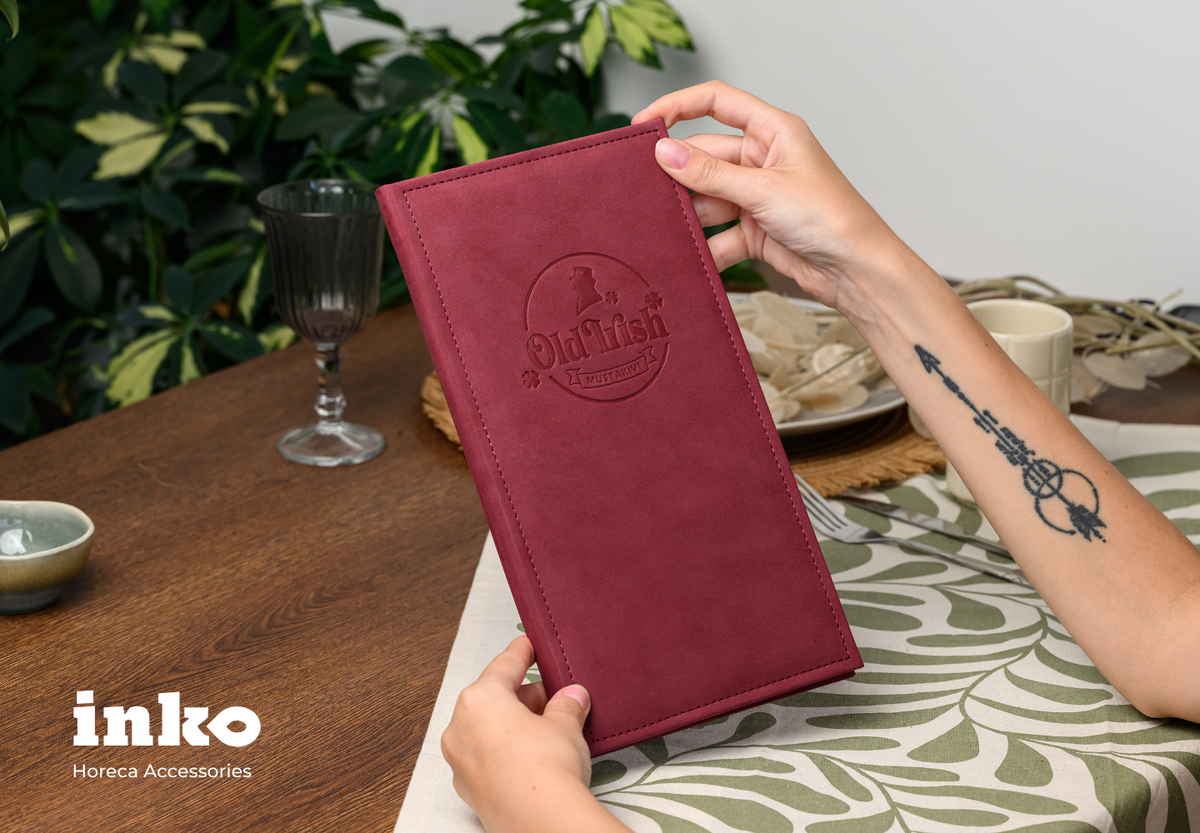
A guest sits down, picks up the menu, and within half a second has already formed an opinion about the place. They haven't ordered anything yet. Haven't tasted anything. Haven't spoken to a server. But the verdict — "this place is expensive and good" or "this place is ordinary" — has already been made, and a large part of that verdict comes down to touch.
We've been manufacturing menu covers for over ten years. Thousands of covers have passed through our shop in that time, and the most interesting thing we've noticed is this: two restaurants with the same logo, the same format, and the same debossing are perceived differently if the material is different. A laminated sheet. Smooth PU. Genuine leather. Nubuck.
The difference is felt with the fingers, not seen with the eyes.

- PU nubuck is not genuine leather — it's polyurethane with a napped surface that mimics suede.
- The matte texture gives color depth and a velvety touch that smooth materials can't deliver.
- Debossing looks more dimensional on nubuck: the nap creates a natural shadow along the edges.
- Care is dry — a brush and a suede eraser, no damp wipes.
- Not a fit for high-traffic venues or greasy hands such as fast food, street food or kids' areas.
- Our collection includes eight shades, among them Cappuccino, Olive, Bordeaux and Navy Blue.
What PU Nubuck Actually Is
Let's start with the honest part.
This is not genuine nubuck. Genuine nubuck is leather lightly sanded on the grain side, and it doesn't survive well in a restaurant: it absorbs everything, fades, and darkens along the folds within a few months.
PU nubuck is a synthetic, polyurethane-based material with a microfiber nap on the surface. To the touch it's very close to suede; visually it's nearly indistinguishable at arm's length. But it behaves entirely differently: it doesn't soak up moisture the way real suede does, doesn't stretch at the corners, and holds the cover's shape after hundreds of openings.
Why does this matter for a restaurant rather than a design presentation? Because a menu isn't decor. It's an everyday working object that gets opened 40 to 60 times a shift.

Why Texture Works Differently Than a Smooth Surface
Smooth PU reflects light evenly. That makes the color read flat: black looks simply black, burgundy looks simply burgundy.
Nubuck scatters light through its microfiber nap. The same shade on that surface shows two or three gradients depending on the angle the light hits it. In the low light of a wine bar, that reads as expensive without a single decorative element.
And there's one more thing people rarely write about.
A smooth surface feels cooler to the touch. A napped one feels warmer — physically, because less of it makes contact with the skin of the hand. The guest doesn't consciously register this, but they respond to it. We've heard more than once from owners that after switching from smooth covers to textured ones, guests started holding the menu longer. A small thing? Holding it longer means reading longer, which means a better chance they'll order more than what they came in for.
A Logo That Looks More Expensive
Debossing on nubuck is a case where the material does the branding work on its own.
On smooth PU, the impression reads through depth and outline. On nubuck, the nap adds to that: along the edges of the die it flattens, creating a natural shadow. The logo looks more dimensional than it actually is.
The practical takeaway for designers: choose a minimalist mark for nubuck. Thin lines, small type, and intricate monograms get lost on a napped surface — the nap swallows details under 1 mm (about 1/32"). A simple, clean logo, on the other hand, gains from it.
Debossing, engraving, and metal plates — we produce all three branding options on our own equipment, so you can see a sample with your specific logo before the full run goes into production.

Where Nubuck Looks Best
The material doesn't dictate a style. It reinforces the one already there.
Nubuck feels most natural in:
- wine bars and cocktail bars
- steakhouses
- chef-driven restaurants
- specialty coffee shops
- boutique hotels
- lounges and gastropubs
These venues have one thing in common: low lighting, natural textures in the interior, an unhurried atmosphere. In that setting nubuck doesn't stand out — it becomes part of the material palette alongside wood, fabric, and warm metal.
And Who Nubuck Isn't For
We'll be direct here, because you can sell anyone anything, but a client only comes back for a second order if the first one worked.
We don't recommend nubuck if:
- you run fast food, street food, or any format where guests handle the menu while eating. A grease stain is harder to lift out of a nap than off smooth PU;
- the menu lives on an outdoor patio. Humidity and dust are the enemies of a napped surface;
- your venue has a kids' area. Juice and a marker on nubuck are a death sentence for the cover;
- your staff wipes down menus with a damp cloth after every guest. That's standard practice at many chains, and it's fatal for nubuck.
For all of these cases, the right answer is smooth PU leather. It stands up to daily wet cleaning and costs less.
Material Comparison: What to Choose for Your Format
| Criterion | PU nubuck | Smooth PU | Genuine leather | Fabric |
|---|---|---|---|---|
| Feel | Velvety, warm | Smooth, cool | Dense, "alive" | Soft, homey |
| Wet cleaning | No | Yes, daily | Limited | No |
| Debossing look | Dimensional, with shadow | Crisp, outlined | Deepest | Weak — use a metal plate |
| Color stability | High | High | Develops a patina over time | Medium |
| Best-fit venue | Wine bars, steakhouses, boutique hotels | High traffic, chains | Classic fine dining | Casual and family cafés |
Care: Three Minutes a Week
The most common mistake with nubuck is wiping it down with a damp cloth "like regular leather." After that the nap clumps into patches, and restoring an even texture is nearly impossible.
Proper care looks like this:
- Every few days — go over it with a soft dry brush in one direction. This lifts the nap and removes dust.
- Spot cleaning — a suede eraser or a spray made for nubuck surfaces. Apply to a dry surface, then brush the nap back up.
- What not to do — don't wet it, don't scrub it with alcohol wipes, don't dry it on a radiator.
Staff pick this up in a single shift. A brush costs almost nothing and lives behind the bar next to the towels.
Eight Shades and How to Pick Yours
The collection comes in eight colors: from classic black to warm Cappuccino, Olive, Bordeaux, and Navy Blue.
How do you choose without a designer? The simplest rule we give clients: don't match the logo color — match the color of the largest surface in the dining room. Tabletops, chair upholstery, walls. The cover should settle into the interior, and the logo on it will do the rest of the work.
A few combinations that consistently work:
- dark wood plus brass accents — Bordeaux or black
- light oak and whitewashed wood — Cappuccino
- green walls and lots of plants — Olive
- nautical theme and bright interior — Navy Blue
And if you're unsure, go black. It never loses; it's just less memorable.
Pre-Order Checklist

Frequently Asked Questions
A guest doesn't analyze the cover material. They simply sense that the place is thought through down to the details — or that the menu here is just a formality.
Sometimes one well-chosen cover says more about a restaurant's level than several pages of brand philosophy on the website.
Need Help Choosing the Right Menu Cover?
Contact our team to discuss the right format, material, color and customization options for your restaurant or hospitality business.
Contact UsIs nubuck genuine leather?
No. PU nubuck is a synthetic, polyurethane-based material with a microfiber nap that mimics suede. We don't recommend genuine nubuck for restaurant menus: it picks up grease quickly and darkens along the folds.
How long does a nubuck cover last?
With normal use in a restaurant with average traffic, several years. The main wear factor isn't time, it's how it's cared for. Wet cleaning cuts the lifespan dramatically.
Can a logo be applied to nubuck?
Yes. Debossing works, as does a metal plate. Simple, clean marks look best: the nap flattens along the edge of the die and creates a natural shadow, which makes the impression look more dimensional.
How do I clean a nubuck menu cover?
A soft dry brush on a regular basis, and a suede eraser or nubuck spray for stains. No water, no alcohol, no damp wipes.
How is nubuck different from smooth PU leather?
Texture and care. Nubuck is warm to the touch, gives deeper color and more dimensional debossing, but requires dry care. Smooth PU is easier to live with, handles daily wet cleaning, and suits high-traffic venues.
What colors are available?
Eight shades, including black, Cappuccino, Olive, Bordeaux, and Navy Blue.
Can I order a custom size?
Yes, we manufacture to your specific menu format. Minimum quantities and lead times depend on complexity — those are best confirmed directly.


Dejar un comentario
This site is protected by reCAPTCHA and the Google Privacy Policy and Terms of Service apply.