




Menu Covers · Leather · Restaurant Branding
Your menu cover is the first thing a guest touches. Not the food. Not the decor. The menu. And that first two seconds of contact — the weight, the texture, whether it feels like something or nothing — sets the tone for everything that follows.
We've supplied menu covers to restaurants in over 45 countries. The owners who invest in a proper leather cover almost never go back. The ones who hesitate and order laminated plastic usually reorder leather within a year, after their staff goes through three replacements and guests keep flipping the thing upside down trying to figure out how it opens.
This guide is for anyone running a venue with a menu — whether you're choosing covers for the first time, switching from something that isn't working or simply trying to understand why your current setup feels off. We'll cover material choices, binding mechanisms, what actually holds up in a busy dining room and which specific styles work for which type of venue.
Key Takeaways
- Genuine leather and quality PU leather differ more in feel than in looks — but both outlast vinyl and laminated covers by years
- The binding mechanism matters as much as the material — the wrong mechanism for your menu format means constant headaches
- Debossed logos look more expensive than printed ones, every time
- Dark and natural tones (black, cognac, dark brown) hide wear far better than light colors in a working restaurant
- Hardcover leather lasts longer in high-traffic venues; soft covers work better for table-service with frequent page changes
- Trifold designs are underused — great for compact tables and cocktail or wine lists
Why the Cover Material Signals More Than You Think
Nobody consciously evaluates your menu cover. That's not how it works. Guests pick it up, feel the weight, register the texture and form an impression in under two seconds. No deliberation. No comparison. Just a subconscious signal: this place either cares or it doesn't.
 Thin PVC or laminated cardboard sends one signal. Genuine leather — or quality full-grain PU — sends another.
A real example: A small Italian restaurant in Berlin, 35 seats, tight budget. They'd been using printed paper sleeves inside plastic holders. They switched to our soft leather covers with elastic cord binding. Same menu, same food. Within a month guests were commenting on the menus. One Google review specifically mentioned "the beautiful leather menus." That's a $15 cover doing the work of a much bigger investment.

Here's what the material actually changes:
- Weight and feel: real leather has a specific gravity that cheap materials can't replicate. Guests notice without knowing they notice.
- Durability: genuine leather develops patina and character over time. The longer it stays in service, the more considered it looks — it becomes part of the venue's identity rather than just an accessory.
- Surface behavior: good leather repels light moisture and fingerprints. It wipes clean. It doesn't get sticky after six months of service.
- Brand signal: when a guest picks up a cover with a debossed logo, it sends a clear message — this venue cares about its identity and paid attention to the details. That impression is formed before they read a single dish.
Genuine Leather vs PU Leather: Two Great Options, Different Strengths
We work with both genuine leather and eco-leather (PU) because both have real advantages. The choice isn't about which one is better — it's about which one fits your venue, your service style and your priorities. Here's how they differ in practice:
| Feature | Genuine Leather | Eco-Leather (PU) |
|---|---|---|
| Look at first glance | Rich, natural grain with visible texture variation | Uniform, clean finish with a slight sheen — vivid and consistent color |
| Feel in hand | Soft, warm, slightly matte — develops patina over time | Smooth and slightly cooler to the touch, consistent across all units |
| Surface character | Light scratches from daily handling — these buff out easily with a cloth or your hand and add to the natural character | Smooth surface does not scratch from handling — stays looking uniform throughout its service life |
| Color range | Natural, muted tones — colour deepens beautifully with age | Wider range of vivid, consistent colors that hold over time |
| Moisture resistance | Good with basic care and conditioning | High — wipes clean instantly, ideal for fast-paced service |
| Debossing / engraving | Excellent — deep, rich impression that holds long-term | Good — clean, precise result with slightly less depth |
| Price range | Higher per unit | More accessible, especially for bulk orders |
| Best for | Fine dining, wine bars, upscale hotels — anywhere the cover is meant to age and tell a story | Mid-range, bistros, high-turnover venues — anywhere consistency, color and easy maintenance matter |
Both materials produce a result that is significantly better than laminated cardboard or cheap vinyl. The difference between genuine and eco-leather comes down to texture, character and how the cover ages — not to which one is the right choice in absolute terms.
The Binding Question: This Is Where Most Owners Go Wrong
Pick the wrong binding mechanism and even a beautiful leather cover becomes a problem. Pages fall out. Menus can't be updated without tools. Staff wastes time. Guests fidget with covers that don't open flat.
Five mechanisms. Each has a specific use case.
Ring Binder
Classic O-ring mechanism, usually 3 or 4 rings. Best for multi-page menus with inserts that need changing regularly (seasonal updates, specials). Pages snap in and out in seconds. The cover also features leather corner inserts — a practical detail that makes it easy to place a weekly offer card, a new dish announcement or a promotion right on the cover without changing anything inside. If you have a large menu and the style in the photo looks like what you need, you can see more photos and details here (LM11A4).

Elastic Cord
Minimalist. The spine has an elastic string that holds folded inserts together. Zero hardware, clean look, very tactile. Best for shorter menus — 4 to 8 pages. Some of our best-reviewed covers use this system, including the soft leather cover LM06A4. Works especially well for wine lists and cocktail menus where page count stays consistent.

Screw Post (Plank Fixing)
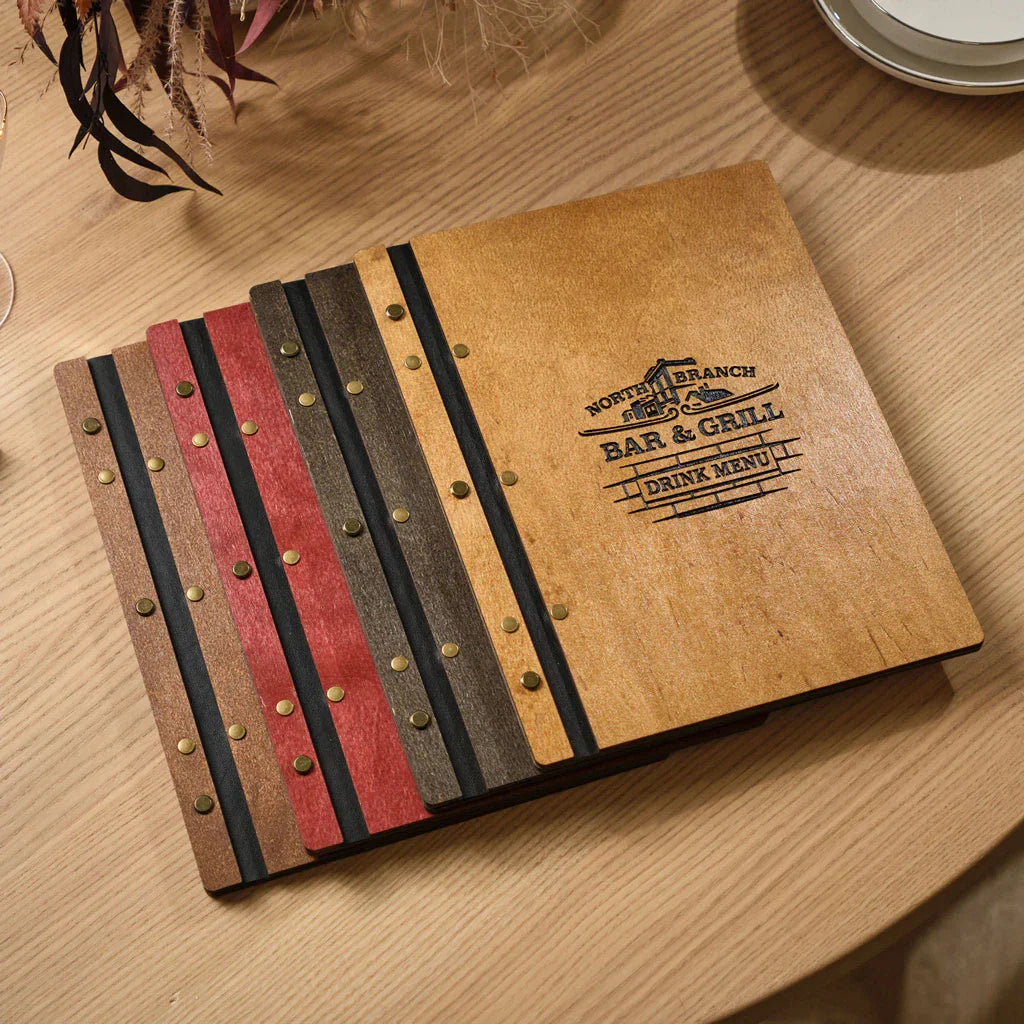
Screws through the spine hold a wood or metal plank, clamping the inserts in place. Takes a few minutes to update pages but the result is very rigid and flat-opening — and it looks as good as it performs. The clean, structured spine gives these covers a particularly sharp, considered appearance on the table. Our faux leather FM02A10 uses this system — popular with venues where menus change quarterly or less. Zero risk of pages falling out mid-service.

Corner Mountings
Metal corner fittings hold the pages at the corners, no spine mechanism at all. The most open and minimal look — pages sit flat and visible across the full width. This format works best for single or double-sheet menus: a prix fixe, a daily special or a tasting menu where the full content fits on one or two printed sheets. Our Custom Luxe cover with corner fixings is a premium option in this category — clean, precise and well-suited to venues where every detail on the table is considered.

Trifold
Three panels, no inserts needed, content is printed or slipped into pockets. Compact and fast to pick up and read. The LM16A2 trifold is ideal for venues with small tables (tapas bars, coffee shops, bar counters) where a standard A4 cover would be unwieldy. Also excellent as a drinks-only or cocktail menu alongside a separate food menu.

Choosing by Venue Type: A Practical Reference
| Venue Type | Recommended Material | Recommended Binding | Notes |
|---|---|---|---|
| Fine dining / upscale hotel | Genuine leather | Corner mountings or screw post | Debossed logo essential. Menus change infrequently. |
| Mid-range restaurant / bistro | Genuine or quality PU | Ring binder or elastic cord | Seasonal updates need to be quick. Ring binder is practical. |
| Wine bar / cocktail bar | Genuine leather | Elastic cord or trifold | Short page count. Premium feel matters for upselling. |
| Casual dining / high-turnover | Quality PU leather | Screw post or ring binder | Durability and easy cleaning are the priority. |
| Café / coffee shop | PU leather or soft genuine | Trifold or elastic cord | Compact formats work well at small tables. |
| Hotel in-room dining | Genuine leather | Hardcover with corner fixings | Menus stay in rooms for months. Durability and luxury both matter. |
Colors, Finishes and Logo Customization
Dark colors. That's the short answer if you're running a busy restaurant and want covers that still look good six months in.
Black, dark brown, cognac, dark green — these handle the daily reality of a working dining room. Spills, fingerprints, heat from plates set too close. Light beige looks stunning on a product photo and shows every mark by week three of service.
That said, some venues can pull off lighter tones. Beach restaurants, Scandinavian-style minimal cafes, venues with very low turnover and controlled environments. Natural tan and sand tones look genuinely beautiful in genuine leather, especially as they age.
On customization: debossing is worth doing if you care about brand perception. The difference versus a printed sticker or UV-printed logo is significant. Embossed leather reads as intentional. A sticker reads as afterthought.
We offer five debossing finishes — each gives a different visual effect on the same logo:
- Blind debossing: the logo is pressed into the leather with no added color or foil. Subtle, dimensional, elegant. Works beautifully on any leather and is the most understated option.
- Gold foil: warm metallic finish that catches light. Classic for wine bars, hotel restaurants and fine dining.
- Copper foil: warmer than gold, with a craft feel. A good match for artisan bistros and natural-interior concepts.
- Silver foil: cool metallic finish that suits modern and minimal spaces.
-
Black foil: high contrast on lighter leathers, sharp and graphic. Works particularly well on tan, sand or cognac tones.

One thing worth knowing before you choose your leather type: not all leathers take debossing the same way. Crazy Horse leather has a natural, slightly textured surface — the impression from debossing sits particularly well on it and the result has real depth. Capri leather is smoother and more uniform, which gives a very clean and precise debossed result. Both work. The choice comes down to the overall aesthetic you're going for. Not sure which fits your logo or interior style? Just send us your logo and we'll suggest the right combination before you order.
Before You Order: A Practical Checklist
- How often does your menu change? Frequently (weekly/monthly): ring binder. Quarterly or less: screw post or corner fixings. Rarely: hardcover or trifold.
- How many pages does your menu have? 1–4 folded sheets: elastic cord or trifold. 5–20 pages: ring binder or screw post. 20+: ring binder with sufficient ring diameter.
- What's your table size? Small tables (bar, café, tapas): consider trifold or A5 format. Standard dining tables: A4 or US Letter is fine.
- What's your daily cover count? Under 50: genuine leather makes sense. 100+: quality PU or genuine leather both work but PU is easier to maintain at scale.
- Do you want a logo on the cover? Plan for this before ordering. Debossing is done at the production stage, not after. Choose your foil finish (blind, gold, copper, silver or black) at the same time.
- Do you need wine or cocktail menus separately? Separate smaller format covers for wine lists look more intentional than squeezing everything into one multi-page binder.
Still not sure which binding mechanism fits your setup? Send us a message — we ask a few questions and point you to the right option without the guesswork.
Our Leather Menu Cover Options at a Glance
Everything below is handmade to order in Uzhhorod, Ukraine and shipped worldwide — genuine leather, quality eco-leather and hardcover options, all available with custom debossing in blind, gold, copper, silver or black foil.
- LM11A4 — Leather Ring Binder Cover: Classic ring mechanism, A4 format. The most popular option for mid-range restaurants with rotating menu inserts.
- LM06A4 — Soft Leather Elastic Cord Cover: Minimal hardware, soft genuine leather feel. Best for wine lists, cocktail menus or short food menus with a consistent page count.
- FM02A10 — Faux Leather Screw Post Cover: Clean screw mechanism, quality PU exterior. Great for high-turnover venues where menus stay consistent but durability is critical.
- Custom Luxe — Leather with Corner Fixings: Premium presentation, full customization. For fine dining and hotel dining rooms where every detail matters.
- LM16A2 — Leather Trifold Cover: Compact three-panel format. Ideal for bar counters, small tables and venues using separate food and drinks menus.
What is the best leather menu cover for a busy restaurant?
How long do genuine leather menu covers last?
Can I add my restaurant logo to a leather menu cover?
What is the difference between a screw post and a ring binder menu cover?
Is genuine leather or faux leather better for restaurant menu covers?
What size leather menu cover should I choose?
How do I clean and maintain leather menu covers?
Can I order leather menu covers in small quantities?
The right menu cover is not a luxury purchase — it is a working tool that guests interact with every single service. Get the material and mechanism right for your venue and it will run quietly in the background for years, doing exactly what it should: making the first impression count. If you have questions about a specific product or need help choosing between options, we're easy to reach and happy to point you in the right direction before you order.


Dejar un comentario
This site is protected by reCAPTCHA and the Google Privacy Policy and Terms of Service apply.